What Does a Top SEO Expert in the USA Actually Do Differently?
Posted
•
August 20, 2026
 Nurture Edge Digital LLP
 Nurture Edge Digital LLP
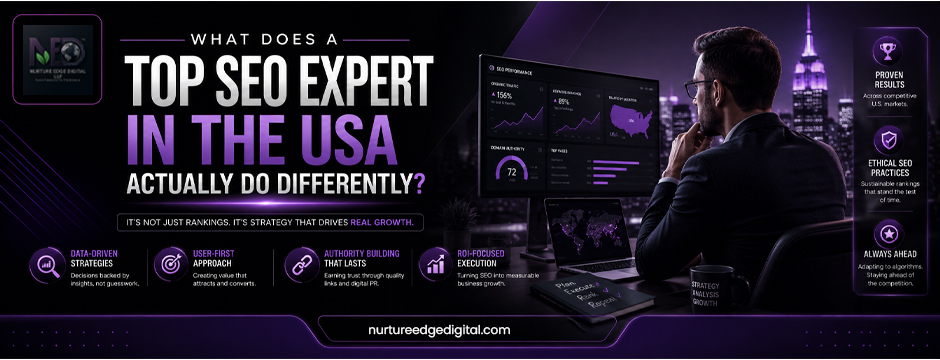
The answer is not more keywords, more blog posts, or a larger backlink spreadsheet. A leading expert connects search visibility with business revenue, customer intent, technical performance, brand authority, and AI discovery. They understand what should be optimized, why it matters, and how the work contributes to measurable growth.
The distinction is becoming more important as the US SEO market expands. Recent searches indicate that North America represented more than 39% of the global SEO services market in 2026, while on-page optimization accounted for roughly 45% of demand.
Search has changed dramatically. People no longer discover businesses only through traditional Google results. They now use AI-generated answers, conversational search, maps, reviews, videos, and comparison platforms before making a decision. As a result, AI SEO optimization is becoming part of a broader search strategy rather than a separate technical exercise.
An average SEO campaign may begin with keyword research.
An expert starts somewhere else: the business model.
Before creating a content calendar, they want to understand the products, margins, sales cycle, customer lifetime value, competitors, geographic markets, and conversion process. This information determines which search opportunities deserve investment.
For example, a B2B software company should not measure success solely by organic sessions. A smaller number of highly qualified visitors can be more valuable than thousands of low-intent visits.
Therefore, advanced SEO reporting connects organic performance with:
This changes the entire strategy. Instead of asking, “How can we rank this keyword?” the better question becomes, “Which search demand can create meaningful business value?”
Modern search requires businesses to think beyond conventional rankings. AI SEO optimization focuses on making a website understandable, extractable, credible, and useful across AI-powered discovery environments.
Google AI Overviews and other generative search experiences can answer questions before users visit a website. Recent US research found that 68.01% of Google searches resulted in no click during the first four months of 2026.
Consequently, visibility cannot be defined only by blue-link rankings.
A sophisticated consultant considers whether a brand can:
This is why businesses increasingly evaluate top AI SEO agencies based on their ability to connect traditional SEO with emerging discovery channels.
The strongest top AI SEO agencies do not abandon conventional SEO. Instead, they strengthen technical foundations, content quality, authority, and structured information so those assets can support both search engines and AI systems.
Technical SEO is still fundamental. However, an experienced consultant does not stop after checking page speed and broken links.
They investigate how search engines access, interpret, render, and index the entire website.
A technical investigation can include:
The consultant examines robots directives, XML sitemaps, canonicalization, redirects, duplicate URLs, pagination, faceted navigation, and index coverage.
Large websites can hide important content behind JavaScript. An expert checks whether critical content and links are available to crawlers after rendering.
The relationships among categories, products, services, resources, and supporting pages matter. A logical architecture helps users and search systems understand topical relationships.
Relevant schema can clarify entities, products, organizations, articles, services, authors, and other information. It does not guarantee rich results, but it can improve machine understanding when implemented correctly.
The important difference is prioritization. A strong consultant does not produce a 100-page audit simply to look thorough. They identify technical problems that can affect visibility, conversions, crawl efficiency, or future scalability.
Publishing more content is not automatically an SEO strategy.
Top consultants map content to the questions people ask before, during, and after a purchase.
A potential customer may begin with an educational question. Later, they may compare providers, investigate pricing, evaluate features, check reviews, and finally search for a specific company.
Each stage requires different content.
For instance, a healthcare company could create:
This creates a connected content ecosystem instead of a collection of unrelated articles.
It also makes internal linking more meaningful. Pages support one another because they represent different parts of the same customer journey.
Traditional SEO often rewarded pages that matched keywords and satisfied ranking signals. Modern search demands clearer information architecture.
An experienced consultant uses answer engine optimization services New York businesses can apply even when their audience extends beyond New York: direct answers, descriptive headings, concise explanations, factual support, structured lists, and clearly defined entities.
For organizations targeting AI discovery, answer engine optimization services New York strategies can be particularly useful for location-specific queries, professional services, healthcare searches, and competitive commercial terms.
The principle is simple: answer the question before forcing the reader to search through the page for it.
This improves usability while making information easier for search systems to interpret.
Generative Engine Optimization focuses on the likelihood that authoritative information will be referenced by generative systems.
That requires more than inserting an AI-related keyword.
Content should demonstrate:
A business looking for the best answer engine optimization services for AI visibility should therefore examine the provider's methodology, not simply its promises about AI rankings.
The same applies when evaluating the best answer engine optimization services for AI visibility. Ask how the agency measures mentions, citations, query coverage, entity associations, and business outcomes.
Search engines increasingly understand relationships between people, organizations, products, services, places, and topics.
That means a company cannot establish authority simply by repeating its target phrase across dozens of pages.
An expert develops a coherent entity footprint.
For a law firm, this might involve consistent information about its attorneys, practice areas, locations, publications, professional profiles, awards, and authoritative references.
For an e-commerce brand, it may involve products, categories, attributes, reviews, manufacturer information, editorial coverage, and third-party references.
The goal is consistency.
If different sources describe a company differently, machine understanding becomes harder. Therefore, entity optimization often extends beyond the website into business profiles, industry publications, directories, social platforms, and other authoritative locations.
AI-generated content has made generic writing easier to produce. It has also made genuine expertise more valuable.
A serious SEO program therefore incorporates experience and evidence into content production.
That may include:
An AEO agency in the USA serving a regulated or high-trust industry should be especially careful here. Healthcare, finance, legal, and other sensitive sectors need content that is accurate, responsible, and demonstrably credible.
An AEO agency in USA should also understand that formatting alone does not create authority. Clear answers help, but expertise must support those answers.
Backlinks still matter, but sophisticated SEO teams have moved away from indiscriminate link acquisition.
Instead, they pursue relevant editorial mentions and genuine authority signals.
A useful digital PR campaign might involve original research, expert commentary, industry studies, data-led stories, thought leadership, or newsworthy company developments.
The objective is not to collect hundreds of links.
It is to earn references that strengthen the brand's reputation and topical relevance.
This approach is especially valuable for competitive industries where many websites publish similar content.
SEO recommendations are worthless if nobody implements them.
Top experts understand organizational constraints. They work with developers on technical fixes, content teams on editorial execution, designers on user experience, and leadership on priorities and budgets.
They also know how to communicate SEO in business language.
Instead of saying, “We need to improve internal linking,” they can explain which pages deserve greater authority, what commercial opportunity exists, and what implementation effort is required.
That ability to turn analysis into action is one of the clearest differences between strategic SEO consulting and routine reporting.
Rankings remain useful diagnostic indicators. They are not the complete scorecard.
A mature program evaluates several layers of performance:
|
|
|
|
|
|
|
|
|
|
|
|
|
|
|
|
|
|
|
|
|
|
|
|
SEO also takes time. US businesses often invest for several months before measurable lead-generation results become clear. The exact timeline depends on competition, authority, technical health, content quality, and implementation speed. Current US agency pricing commonly falls around $3,000–$7,500 per month, although scope varies significantly.
When comparing providers, avoid choosing purely on ranking claims.
Instead, ask practical questions:
A capable consultant should provide clear answers without promising guaranteed AI placements.
If an agency claims it can control exactly what Google, ChatGPT, or another AI system recommends, treat that claim cautiously. Search visibility is earned through relevance, accessibility, authority, and usefulness. No legitimate provider controls another company's algorithm.
The best GEO agency in the USA should integrate generative search strategy with established SEO fundamentals.
That means improving technical accessibility first, then developing authoritative content, strengthening entity signals, identifying conversational queries, and monitoring how the brand appears across relevant AI experiences.
The best GEO agency in the USA should also understand that AI visibility is not an isolated campaign. It is the result of a strong digital footprint built over time.
Nurture Edge Digital combines 3+ years of hands-on experience with a human-first approach to SEO, AI search visibility, and digital growth. With 5+ projects delivered and 98% client satisfaction, the brand focuses on building partnerships, not chasing vanity metrics. Founded by Rachna Vermaa, an export-business entrepreneur turned digital growth strategist, Nurture Edge Digital blends business insight, AI SEO optimization, and buyer psychology to help brands attract prospects with clarity, credibility, and purpose across competitive global markets with sustainable long-term growth.
The biggest difference between an average SEO provider and a top SEO expert in the USA is strategic depth. A leading expert does not chase rankings for their own sake. They understand the business, technical infrastructure, customer journey, content ecosystem, authority signals, and emerging AI search environment.
AI SEO optimization brings these disciplines together by making valuable information easier for modern discovery systems to understand and trust. However, AI SEO optimization should never become an excuse to ignore fundamentals. Strong technical SEO, useful content, credible authorship, relevant authority, and excellent user experience remain the foundation.
For businesses seeking a practical, sustainable approach to modern search visibility, Nurture Edge Digital can help build an SEO strategy that connects traditional search performance with AI-era discovery, authority, and measurable business growth.
A top SEO expert connects search visibility with business outcomes. They combine technical SEO, buyer-intent content, entity authority, AI search optimization, digital PR, and revenue-focused reporting instead of focusing only on keyword rankings.
A modern SEO expert should cover technical SEO, content strategy, AEO, GEO, structured data, analytics, conversion tracking, AI visibility monitoring, and integrations with relevant search and reporting platforms.
US SEO retainers commonly range from $3,000 to $7,500 monthly, depending on scope and competition. Onboarding typically begins with business goals, technical audits, competitor research, keyword mapping, and a prioritized strategy.
Choose an expert who uses transparent reporting, ethical SEO practices, secure access procedures, credible content, clear documentation, and measurable KPIs. Avoid providers promising guaranteed rankings or guaranteed AI recommendations.
Leading experts go beyond backlinks and rankings. They connect SEO with revenue, build topical and entity authority, optimize for AI discovery, collaborate with implementation teams, and continuously refine strategies using real performance data.