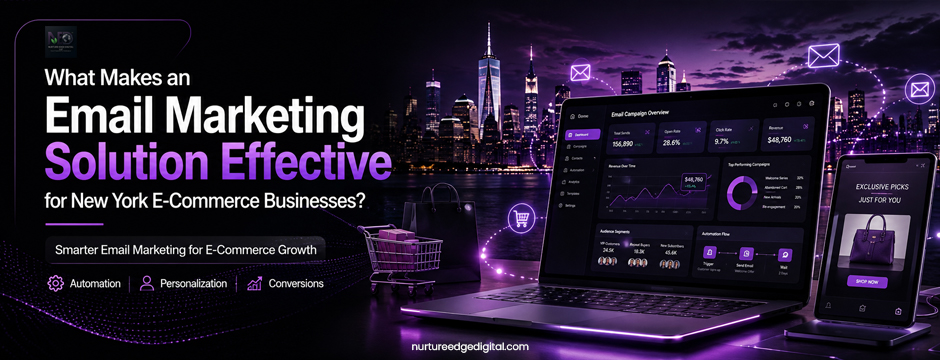
New York e-commerce is crowded, fast-moving, and highly competitive. Customers can compare products within seconds, switch stores easily, and ignore brands that send irrelevant messages. For online retailers, email is therefore more than a channel for promotions. It can support customer education, repeat purchases, retention, and long-term relationships.
An effective Email marketing service in New York combines strategy, customer data, automation, useful content, and careful measurement. The goal is not simply to send more emails. It is to send the right message to the right customer at a useful moment.
Why Email Marketing Matters for New York E-Commerce
New York businesses serve a diverse customer base. A fashion store may attract local shoppers, tourists, national customers, and international buyers. A beauty retailer may have customers with very different product preferences.
This makes generic email campaigns less useful.
Email allows retailers to build direct communication with people who have already shown interest. Someone who browses a product can receive relevant information later. A previous customer can hear about complementary products. An inactive subscriber can receive a carefully designed re-engagement message.
Furthermore, email gives brands greater control over customer communication. Social platforms can change algorithms, reach can fluctuate, and paid advertising costs can rise. An owned email audience provides another dependable route to customers.
What Makes an Effective Email Marketing Solution?
An effective Email marketing solution in New York should combine several capabilities rather than operate as a basic newsletter service.
1. Smart Audience Segmentation
Segmentation divides an audience according to meaningful characteristics or behaviors.
Useful segments may include:
- First-time customers
- Repeat purchasers
- High-value customers
- Recent subscribers
- Product-category shoppers
- Cart abandoners
- Inactive subscribers
- Customers who have not purchased recently
For example, a customer who repeatedly purchases skincare products should not receive the same message as someone who only buys accessories.
A good Email marketing company in New York uses purchase history, browsing behavior, engagement, and customer preferences to make these distinctions practical.
2. Relevant Personalization
Personalization should go beyond inserting a customer's first name.
A stronger campaign considers what the customer actually does. Product recommendations can reflect previous purchases. Content can respond to browsing activity. Offers can match customer interests.
However, personalization must remain useful rather than intrusive. Customers should feel understood, not monitored.
For New York retailers, this distinction matters because audiences are sophisticated and exposed to large volumes of digital advertising every day.
3. Automated Customer Journeys
Automation helps an e-commerce brand respond consistently without requiring manual action for every interaction.
A basic customer journey might include:
Welcome → Product education → Purchase reminder → Post-purchase support → Cross-sell → Re-engagement
Different triggers can activate different sequences.
For instance, a new subscriber might receive a welcome series. A shopper who abandons a cart could receive a reminder. A recent buyer might receive product-care information before being introduced to complementary products.
Consequently, automation gives marketing teams more time to focus on strategy and creative work.
How Email Automation Supports E-Commerce Growth
Automation becomes particularly valuable when customer journeys contain many touchpoints.
Welcome Emails
The first few messages establish expectations. They can introduce the brand, explain key products, highlight useful resources, and clarify what subscribers can expect.
Abandoned Cart Emails
Customers often leave products behind for practical reasons. They may become distracted, compare alternatives, or postpone the purchase.
A timely reminder can bring the product back into consideration without requiring another paid acquisition campaign.
Post-Purchase Emails
The relationship should not end after checkout. Order information, usage guidance, care instructions, and related product recommendations can improve the customer experience.
Re-Engagement Campaigns
Inactive subscribers may still have commercial value. A targeted re-engagement campaign can identify whether they remain interested before reducing communication frequency or removing unresponsive contacts.
The Role of Strong Email Content
Technology cannot compensate for weak messaging.
A successful email needs a clear purpose. The reader should quickly understand why the message matters.
Subject lines should be specific rather than exaggerated. The opening should establish relevance. The body should provide enough information to support a decision. Finally, the call to action should tell the reader what to do next.
An Email marketing solution company should also understand the difference between promotional and informational content.
A promotional email may introduce a limited offer. An educational email might explain how to choose between products. A post-purchase message may solve a customer problem. This variety prevents every interaction from feeling like a sales pitch.
Mobile Experience and Conversion Design
Many customers read email on smartphones. Therefore, mobile usability should be treated as a core requirement rather than an optional design feature.
Effective emails usually have:
- Clear visual hierarchy
- Readable text
- Concise copy
- Prominent calls to action
- Responsive layouts
- Well-structured product information
- Fast-loading images
- Adequate spacing between clickable elements
The landing page must also support the email's promise. If an email promotes a specific collection, sending customers to an unrelated homepage creates unnecessary friction.
This is where an Email marketing service in New York should connect email strategy with website experience and conversion optimization.
CRM Integration and Customer Data
Email performs better when it is connected to reliable customer data.
Integration with an e-commerce platform or CRM can help marketers understand purchase frequency, order value, product interests, and engagement patterns.
A connected system can also prevent awkward communication. For example, customers who have already purchased an advertised item should not continue receiving a message designed specifically to convince them to buy it.
Data quality matters just as much as data quantity. Duplicate records, outdated information, and poorly maintained lists can weaken campaign performance.
Testing and Performance Measurement
Good email marketing is measurable.
An Email marketing company in New York should evaluate performance using metrics that correspond with business objectives.
Important indicators include:
- Delivery rate
- Open rate
- Click-through rate
- Conversion rate
- Revenue per campaign
- Revenue per recipient
- Unsubscribe rate
- Customer retention
- Repeat purchase rate
Testing can reveal what actually works. Marketers can compare subject lines, calls to action, offers, layouts, product selections, and send times.
However, one metric should never be viewed in isolation. A high click rate means little if visitors fail to purchase. Similarly, an impressive open rate does not automatically indicate strong revenue.
Deliverability and Responsible Email Practices
Getting an email into the inbox is a technical and strategic challenge.
A responsible program maintains clean subscriber lists, monitors bounce rates, manages sender reputation, and removes persistently unresponsive contacts when appropriate.
Permission also matters. Businesses should use legitimate acquisition methods and provide clear subscription expectations.
An Email marketing solution in New York should therefore consider deliverability from the beginning rather than treating it as a problem that appears after campaigns begin.
Trust is especially important for e-commerce because customers share personal and payment-related information with brands. Clear communication and responsible data handling help protect that relationship.
Local Relevance Without Over-Personalization
New York offers opportunities for locally relevant campaigns. A retailer with a physical presence might promote a Manhattan store event, local pickup option, seasonal collection, or city-specific experience. A purely online business can still use regional interests where appropriate.
However, location should support relevance rather than become an excuse for excessive personalization.
Specifically, marketers should ask whether location changes the customer's decision. If it does, use it. If it does not, another segmentation factor may be more useful.
What Should Businesses Look for in a Provider?
When evaluating an Email marketing service in New York, businesses should look beyond attractive templates or promises of quick results.
Ask potential providers:
- How do you segment customer audiences?
- Which automation journeys do you recommend?
- How will email connect with our CRM or store?
- How do you approach deliverability?
- Which metrics will you report?
- How frequently will campaigns be tested?
- How do you protect subscriber data?
- How will email support our wider acquisition and retention strategy?
The answers reveal whether a provider understands e-commerce operations or simply sells campaign execution.
Common Mistakes to Avoid
Some email programs fail because the strategy is too broad.
Sending every subscriber the same promotion can cause fatigue. Sending too frequently can increase unsubscribes. Sending too rarely can weaken brand familiarity.
Another mistake is focusing entirely on discounts. Constant price reductions may train customers to wait for offers rather than value the product.
Poor timing is another issue. An email should have a reason to arrive. Customer behavior, product availability, buying cycles, and campaign objectives should influence scheduling.
Finally, businesses should avoid judging success immediately after one campaign. Email programs become more informative as customer data accumulates and testing produces clearer patterns.
The Future of E-Commerce Email Marketing
Email is becoming increasingly connected with artificial intelligence, predictive analytics, customer data platforms, and cross-channel marketing.
AI can assist with content variations, send-time optimization, product recommendations, audience analysis, and campaign testing. Yet human judgment remains important.
A machine can identify patterns. A marketer must decide whether those patterns make commercial and customer-experience sense.
For New York e-commerce brands, the strongest approach will likely combine automation with thoughtful creative direction. Email should work alongside SEO, paid advertising, social media, website optimization, and customer service rather than operate as an isolated activity.
Drive E-Commerce Growth with Smarter Email Marketing
With 03+ years of experience, numerous projects delivered, and 98% client satisfaction, Nurture Edge Digital helps e-commerce businesses build stronger customer relationships through strategic email marketing. Our tailored approach combines automation, audience segmentation, conversion-focused content, and data-driven optimization to turn prospects into loyal customers.
We focus on practical strategies that support measurable growth, improve engagement, and strengthen retention. With a commitment to long-term partnerships, we deliver reliable digital solutions designed around your business goals and customer journey.
Conclusion
The most effective Email marketing service in New York is not defined by the number of emails sent. Its value comes from relevance, timing, automation, customer understanding, deliverability, and measurable outcomes.
A strong program turns customer data into useful communication. It welcomes new subscribers, supports purchasing decisions, improves post-purchase experiences, and brings inactive customers back into consideration.
For growing retailers, the right Email marketing solution company can also connect these activities with broader e-commerce goals. The result is a communication system that supports both immediate conversions and sustainable customer relationships.
If you are looking for a practical, personalized approach to email campaigns, automation, CRM integration, and customer nurturing, Nurture Edge Digital can help you build an email strategy around your business goals, audience, and growth stage.
Frequently Asked Questions
1. Why is email marketing important for New York e-commerce businesses?
Email marketing helps e-commerce brands nurture leads, recover abandoned carts, encourage repeat purchases, promote products, and maintain direct customer relationships without relying solely on paid advertising or social algorithms.
2. What features should an effective email marketing solution include?
Look for audience segmentation, automated workflows, CRM and e-commerce integration, personalization, mobile-responsive design, A/B testing, analytics, deliverability monitoring, and behavioral triggers based on customer actions.
3. How does email marketing onboarding typically work?
Onboarding generally includes understanding business goals, reviewing customer data, connecting CRM or e-commerce platforms, segmenting audiences, developing automated journeys, creating campaigns, and establishing reporting and testing processes.
4. Is email marketing secure and compliant for e-commerce businesses?
A trustworthy email program uses permission-based lists, responsible data handling, unsubscribe options, clean databases, bounce monitoring, and deliverability practices to protect customer trust and maintain reliable inbox placement.
5. What makes a professional email marketing provider different from competitors?
A strong provider combines e-commerce expertise, personalized strategy, automation, CRM integration, measurable reporting, and continuous optimization rather than relying on generic templates or one-size-fits-all campaigns.
 Nurture Edge Digital LLP