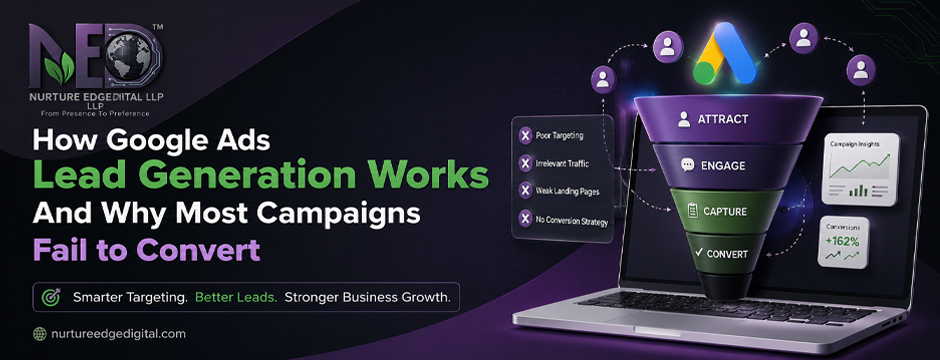
Businesses invest in paid advertising because they want faster visibility, better traffic, and more customers. However, simply running ads on Google does not guarantee results. Many companies spend significant budgets but struggle to generate meaningful inquiries because their campaigns attract the wrong audience, use weak messaging, or fail to guide visitors toward action.
Understanding how Google Ads lead generation works is essential for businesses that want predictable growth. A successful campaign is not just about attracting clicks; it is about generating meaningful conversions and valuable business outcomes.
Google Ads can become a powerful growth channel when managed strategically. However, many campaigns fail because businesses focus only on traffic instead of conversions.
What Is Google Ads Lead Generation?
Google Ads lead generation is the process of using Google’s paid advertising platform to attract potential customers who are actively searching for products, services, or solutions. Instead of waiting for people to discover a business organically, companies can appear at the right moment when users show purchase-related intent.
For example, a manufacturer looking for overseas buyers may target keywords related to product sourcing, suppliers, or industrial solutions. When potential buyers search those terms, the business advertisement appears in front of them.
The goal is not simply to increase website visits. The objective is to collect valuable actions such as:
- Contact form submissions
- Phone calls
- Product inquiries
- Quote requests
- Demo bookings
- Consultation requests
Furthermore, effective campaigns focus on attracting qualified prospects rather than large volumes of random visitors.
How Does Google Ads Lead Generation Work?
Google Ads lead generation follows a structured process that connects businesses with users based on their search behavior, interests, and buying intent.
1. Understanding Search Intent
Every successful campaign starts with understanding what customers are searching for.
A person searching “best accounting software” may only be researching. However, someone searching “accounting software for manufacturing companies pricing” is likely closer to making a decision.
Search intent helps advertisers identify:
- What customers need
- Where they are in the buying journey
- Which keywords indicate strong interest
- What type of message will influence them
Consequently, businesses that understand intent can create advertisements that feel relevant instead of promotional.
2. Selecting the Right Keywords
Keywords are the foundation of every Google Ads campaign. Choosing the wrong keywords can quickly waste advertising budgets.
For lead generation campaigns, businesses should focus on keywords that show commercial intent.
For example:
Low-intent keyword:
“types of industrial machines”
High-intent keyword:
“industrial machine supplier near me”
The second search indicates a stronger possibility of contacting a supplier.
Professional advertisers also use negative keywords to prevent ads from appearing for irrelevant searches. This improves traffic quality and protects the budget.
3. Creating Ads That Match Customer Needs
A common mistake is writing advertisements that only describe the company. Customers are more interested in solutions.
A strong Google ad should communicate:
- The specific problem being solved
- The key benefit offered
- Why the business is trustworthy
- What action the user should take next
For example, an export company should highlight reliability, product quality, certifications, or global supply capability instead of using generic statements.
This is where experienced Google Ads experts add value by creating messaging based on customer psychology and market behavior.
4. Optimizing Landing Pages for Conversions
Getting clicks is only the first step. The landing page plays a crucial role in converting visitors into potential leads. Many campaigns fail because the advertisement promises one thing, but the landing page provides something different.
A high-converting landing page should include:
- A clear headline
- Relevant product or service information
- Strong trust signals
- Simple contact forms
- Customer testimonials or proof points
- Mobile-friendly design
A visitor should immediately understand what the business offers and why they should take action.
Why Do Most Google Ads Campaigns Fail to Convert?
Many businesses assume poor results happen because Google Ads are expensive. In reality, most failures come from strategic mistakes.
1. Targeting the Wrong Audience
One of the biggest reasons campaigns fail is reaching people who are unlikely to become customers. For example, a B2B manufacturer targeting broad consumer keywords may receive many clicks but very few inquiries.
Successful campaigns require precise targeting based on:
- Location
- Industry
- Customer profile
- Search behavior
- Buying stage
For companies selling complex products, B2B Google Ads campaigns require deeper audience research because purchasing decisions often involve multiple stakeholders.
2. Poor Keyword Selection
Many advertisers choose keywords with high search volume but low business value. A keyword receiving thousands of searches may not generate revenue if users are not ready to buy.
Effective keyword strategies balance:
- Search volume
- Competition level
- Customer intent
- Conversion potential
Additionally, keyword performance should be reviewed regularly to remove terms that attract unqualified traffic.
3. Weak Ad Copy
Even with perfect targeting, poor ad messaging can reduce performance. Users compare multiple advertisements before clicking. If an ad does not clearly explain its value, people move to competitors.
Good ad copy should answer:
- Why should someone choose this business?
- What makes the offer different?
- What benefit will the customer receive?
Specific messaging usually performs better than generic claims.
4. Ignoring Conversion Tracking
Many businesses run advertisements without properly measuring results. Without tracking, advertisers cannot understand:
- Which keywords generate leads
- Which ads perform best
- Which audiences convert
- Where money is being wasted
Conversion tracking provides the data needed for better decisions.
Furthermore, businesses should measure meaningful actions instead of focusing only on clicks or impressions.
5. Lack of Continuous Optimization
Google Ads is not a “set and forget” marketing channel. Markets change. Competitors adjust their strategies. Customer behavior evolves.
Successful campaigns require regular improvements, including:
- Bid adjustments
- Keyword updates
- Ad testing
- Audience refinement
- Landing page improvements
This ongoing process is why many businesses choose professional Google Ads management services instead of handling campaigns alone.
The Role of Professional Google Ads Management
Running successful campaigns requires more than creating advertisements. It involves research, analysis, testing, and strategic decision-making.
A reliable Google Ads management service helps businesses manage different aspects of paid advertising, including:
- Campaign structure
- Keyword planning
- Budget allocation
- Performance monitoring
- Conversion improvement
Experienced professionals analyze campaign data to identify opportunities and reduce unnecessary spending.
For businesses with complex sales cycles, expert management can improve lead quality and create a more predictable advertising system.
How Businesses Can Improve Google Ads Conversion Rates
Improving campaign performance requires a combination of strategy and execution.
Focus on Quality Over Quantity
More clicks do not always mean better results. A campaign receiving fewer but highly relevant visitors can outperform one receiving thousands of unqualified clicks.
Improve Your Offer
Customers need a reason to contact your business. Strong offers may include:
- Free consultations
- Product demonstrations
- Detailed catalogs
- Industry-specific solutions
- Custom quotations
Test Different Approaches
Small improvements can create significant changes over time. Businesses should test:
- Headlines
- Descriptions
- Landing page layouts
- Calls-to-action
- Target audiences
Use Data-Based Decisions
Successful advertisers rely on performance data rather than assumptions. Analytics reveal what customers respond to and where improvements are needed.
This approach is central to effective Google Ads optimization services, where campaigns are continuously refined to improve efficiency and results.
Google Ads vs SEO: Which One Should Businesses Choose?
Google Ads and SEO serve different purposes. SEO builds long-term organic visibility and authority. It takes time but can deliver sustainable traffic. Google Ads provides immediate visibility and allows businesses to reach potential customers quickly.
However, many successful companies use both strategies together. Paid advertising can generate immediate leads while SEO builds long-term brand growth.
The right approach depends on business goals, competition, budget, and customer journey.
Best Practices for Successful Google Ads Campaigns
Businesses looking to improve results should follow these practices:
- Define clear campaign goals before launching
- Research customer behavior carefully
- Use relevant keywords
- Create specific advertisements
- Optimize landing pages
- Track conversions accurately
- Review performance regularly
- Adjust strategies based on data
Moreover, businesses should treat advertising as an investment rather than a simple expense.
Turn Clicks into Qualified Leads with Nurture Edge Digital
At Nurture Edge Digital, we help businesses transform Google Ads into a powerful lead generation channel with strategic targeting, data-driven campaigns, and continuous optimization. We create customized advertising solutions for manufacturers, exporters, and B2B brands to reach the right audience and maximize ROI. From keyword research and campaign setup to performance tracking and refinement, our Google Ads experts focus on generating quality inquiries, reducing wasted spend, and building sustainable digital growth through effective Google Ads strategies.
Conclusion
Google Ads can generate powerful business opportunities when campaigns are built around customer intent, accurate targeting, and continuous improvement. However, many campaigns fail because they focus on clicks instead of conversion strategy.
Successful Google Ads lead generation requires understanding customer needs, selecting the right keywords, creating relevant advertisements, and improving performance through data.
When businesses approach Google Ads strategically, they can attract better prospects, reduce wasted spending, and create a reliable source of growth. For companies looking to build effective campaigns with expert guidance, Nurture Edge Digital provides strategic Google Ads solutions designed to help businesses generate qualified leads and achieve sustainable digital growth.
FAQs
1. How does Google Ads lead generation help businesses get more customers?
Google Ads lead generation helps businesses connect with potential customers who are actively searching for their products or services. By targeting relevant keywords and audiences, companies can attract high-intent visitors and convert them into inquiries, calls, or sales opportunities.
2. Why do many Google Ads campaigns fail to generate quality leads?
Many campaigns fail because of poor keyword selection, incorrect audience targeting, weak ad messaging, or ineffective landing pages. Without proper tracking and regular improvements, businesses may spend money on clicks that do not create valuable results.
3. How can businesses improve their Google Ads conversion rate?
Businesses can improve conversions by using relevant keywords, creating customer-focused advertisements, optimizing landing pages, tracking important actions, and continuously testing campaign performance. A data-driven approach helps identify what works best.
4. Are Google Ads suitable for manufacturers and B2B companies?
Yes, Google Ads can be highly effective for manufacturers and B2B companies when campaigns focus on specific industries, buyer intent, locations, and decision-makers. Proper targeting helps attract qualified business inquiries.
5. How long does it take to see results from Google Ads campaigns?
Google Ads can generate visibility and traffic quickly, but consistent results require ongoing monitoring and optimization. Regular adjustments to keywords, bids, ads, and targeting help improve campaign performance over time.
 Nurture Edge Digital LLP