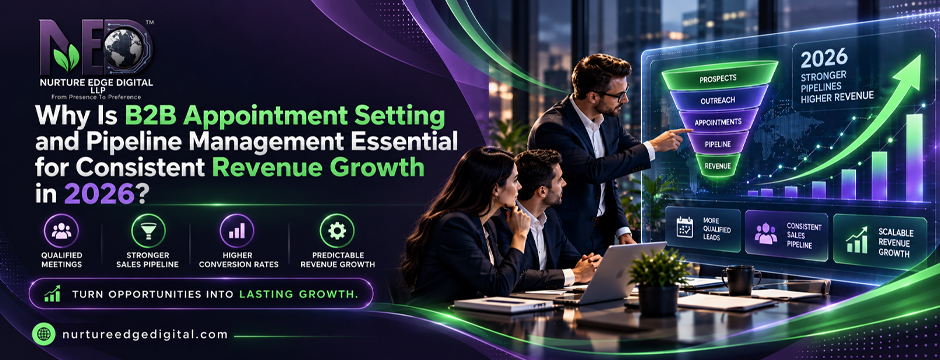
Ever had a month when your sales calendar was packed, followed by another when it felt like everyone had disappeared? You're not alone. Many B2B businesses experience this frustrating cycle. Leads arrive in bursts, follow-ups slip through the cracks, and promising deals suddenly go cold.
The problem isn't always the quality of your product. Sometimes, it's the system behind your sales process.
B2B appointment setting and pipeline management help businesses turn scattered prospecting efforts into a more organised route to revenue growth. One focuses on starting conversations with the right buyers; the other ensures those conversations keep moving towards a decision.
In 2026, when buyers expect relevant communication and sales cycles can involve several decision-makers, having a reliable process matters more than ever. Let's explore how these two functions work together, where businesses often go wrong, and what you can do to build a healthier sales pipeline.
What Is B2B Appointment Setting and Pipeline Management?
Think of your sales process as a journey. Appointment setting opens the door, while pipeline management keeps the journey moving.
B2B appointment setting involves researching potential customers, contacting relevant decision-makers, checking whether they fit your target market, and scheduling sales meetings. The aim is to create meaningful conversations, not simply add names to a spreadsheet.
Pipeline management tracks what happens next. It helps teams organise opportunities, record interactions, monitor deal progress, and decide which action should happen next.
Consider a manufacturing company looking for international distributors. Its outreach team contacts suitable businesses through LinkedIn and email. When a distributor agrees to a meeting, the sales team records the conversation in its CRM, identifies the buyer's requirements, and schedules a follow-up.
Instead of relying on memory or scattered notes, everyone knows where the opportunity stands.
That's the real advantage: a connected process that links prospecting with commercial outcomes.
Why Does a Strong Sales Pipeline Matter for Revenue Growth?
A healthy pipeline gives business owners something valuable: visibility. Rather than wondering where the next customer will come from, they can examine their opportunities, identify weaknesses, and plan their next move.
1. Build a More Consistent Flow of Opportunities
Referrals and inbound enquiries can bring excellent customers. However, relying entirely on them can leave your business exposed when enquiries slow down.
A structured prospecting process creates additional opportunities through planned outreach. Teams can maintain contact with relevant accounts, test different messages, and adjust campaigns when engagement drops.
Furthermore, tracking results across channels helps businesses understand which activities generate worthwhile conversations. This makes it easier to direct time and budget towards effective campaigns instead of repeating activities that produce little value.
2. Make Sales Forecasting More Realistic
Would you plan your next quarter based on money you hope to earn? Probably not!
A properly maintained pipeline provides a more grounded view of potential revenue. It records each opportunity's estimated value, current stage, expected closing date, and next action.
Managers can combine this information with historical conversion rates to create forecasts. However, pipeline value isn't guaranteed revenue. Budgets change, approvals get delayed, and prospects sometimes choose competitors.
For more reliable forecasts, keep records current, define clear sales stages, and use realistic probabilities based on actual performance.
3. Give Sales Representatives More Time to Close Deals
Sales representatives shouldn't spend their entire day searching for contacts and chasing unresponsive prospects. They also need time for discovery calls, demonstrations, negotiations, and relationship building.
A well-organised appointment-setting process handles much of the initial prospecting and scheduling. Sales professionals can then concentrate on conversations that have a reasonable chance of becoming business opportunities.
The benefit is straightforward: better use of sales capacity without automatically increasing headcount.
How Appointment Setting Creates Better Sales Conversations
Getting a meeting booked is only half the job. The real challenge is ensuring that the conversation involves someone who could genuinely benefit from your solution.
Identify Your Ideal Customer
Start by defining your ideal customer profile (ICP). Consider industry, company size, location, business challenges, purchasing authority, and potential contract value.
For instance, an IT services provider offering cybersecurity solutions might target IT directors or security managers at mid-sized companies. These professionals are more likely to understand the business problem than contacts with no involvement in technology decisions.
Next, research the relevant decision-makers and tailor your message to their priorities. A personalised message that addresses a genuine challenge usually gives prospects a stronger reason to respond than a generic sales pitch.
Coordinate Email, LinkedIn, and Cold Calling
Different buyers prefer different communication channels. Some respond to a concise email, others engage on LinkedIn, and some prefer a brief telephone conversation.
A coordinated outreach sequence can combine these channels without bombarding the prospect. Each interaction should add context or provide a useful reason to continue the conversation.
Track responses, positive replies, booked meetings, and negative feedback. These signals reveal whether your messaging is relevant and where improvements are needed.
Qualify Before Booking
Not every interested contact is ready for a sales meeting. Before scheduling an appointment, establish whether the prospect fits your target market and has a relevant business need.
You can also evaluate how soon prospects need a solution, their available budget, their role in purchasing decisions, and when they expect to buy.
Not every first conversation needs to establish every detail. Still, your team should agree on what qualifies as a worthwhile appointment. Otherwise, a busy calendar can hide a disappointing pipeline!
What Happens After the Meeting? The Role of Pipeline Management
This is where many businesses lose momentum. A promising conversation takes place, everyone feels optimistic, and then... nothing happens.
Effective B2B appointment setting and pipeline management prevent opportunities from getting buried under daily tasks.
Create Clear Sales Stages
A typical B2B sales pipeline may include these stages:
- Lead identified: The account matches your target profile.
- Contact initiated: Outreach has started.
- Meeting scheduled: A sales conversation is booked.
- Discovery completed: The prospect's needs and suitability have been assessed.
- Proposal submitted: A relevant offer has been presented.
- Negotiation: Commercial terms or concerns are being discussed.
- Closed won or lost: The outcome is recorded.
Your stages should reflect genuine progress rather than activity alone. Define the conditions for moving an opportunity forward so everyone follows the same process.
Keep Follow-Ups Timely and Personal
B2B purchases rarely happen after a single conversation. Buyers may need internal approval, additional information, or time to compare suppliers.
Every active opportunity should have an owner, a clear next step, and an appropriate follow-up date. CRM reminders can help representatives stay organised, while automation can handle routine notifications and task assignments.
However, automation shouldn't make your communication sound robotic. A thoughtful follow-up that answers a prospect's question is far more useful than another generic message asking whether they've made a decision.
Find and Fix Sales Bottlenecks
A CRM system gives your team a shared record of contacts, conversations, meetings, and opportunities.
Suppose several prospects receive proposals but never move forward. Rather than sending more proposals, investigate the problem. Are prices unclear? Does the offer address the buyer's priorities? Are representatives following up effectively?
B2B appointment setting and pipeline management deliver greater value when the information they generate leads to practical improvements. The goal is not simply to keep the CRM updated; it's to make better sales decisions.
How AI and Automation Can Improve Sales in 2026
Technology can take repetitive work off your team's plate. Used thoughtfully, it also helps businesses understand prospects and make outreach more relevant.
Automate Routine Sales Tasks
CRM workflows can assign leads, schedule reminders, create follow-up tasks, and notify representatives when an opportunity needs attention.
For example, after a discovery call, a workflow might remind the account owner to send a proposal within an agreed timeframe. If the prospect doesn't respond, the system can create a follow-up task.
These tools reduce administrative work, but they still need supervision. Poorly configured automation can create duplicate messages, inaccurate records, and awkward customer experiences.
Use AI for Research and Personalisation
AI tools can assist with account research, summarise publicly available business information, organise prospect data, and help draft personalised outreach.
AI-powered search optimisation can also improve a company's discoverability when buyers research relevant solutions. Clear service pages, useful content, and consistent business information support this effort.
However, appearing in search results or AI-generated answers doesn't guarantee sales meetings. Businesses still need relevant landing pages, clear calls to action, effective qualification, and timely follow-up.
Measure What Actually Matters
Contact volume alone won't tell you whether your sales process is working. Monitor metrics that connect outreach with commercial progress:
- Qualified meeting rate: The proportion of booked meetings that meet your qualification criteria.
- Meeting attendance rate: The percentage of scheduled appointments that take place.
- Opportunity conversion rate: The share of qualified meetings that become genuine sales opportunities.
- Sales cycle length: The average time taken to move through the defined sales journey.
- Win rate: The proportion of eligible sales opportunities that become customers.
- Pipeline value: The estimated value of active opportunities.
- Customer acquisition cost: The cost of acquiring a customer, calculated consistently.
Review these metrics together. A campaign that generates fewer meetings may still deliver better results if those meetings turn into valuable opportunities more often.
When Should You Consider Outsourced Lead Generation?
Building an internal sales development team requires recruitment, training, management, software, and ongoing campaign investment. For businesses with limited resources, outsourcing can provide additional prospecting capacity without immediately building a full in-house team.
Professional B2B lead generation services can help when you understand your target market but lack the time or expertise to research accounts, run outreach campaigns, qualify responses, and book meetings consistently.
They may also suit companies entering new markets or replacing an underperforming prospecting process.
Choose a Partner That Understands Your Sales Goals
Before hiring an agency, ask how it defines a qualified appointment, researches target accounts, manages follow-ups, and reports campaign results.
Clarify who owns the contact data, which channels will be used, and how performance will be measured. Ask how the team responds when meeting quality falls or campaigns underperform.
Be cautious of guaranteed revenue claims or promises of huge meeting volumes without considering your industry, offer, and sales cycle.
The right partner should work alongside your sales team, provide transparent reporting, and adapt its approach based on real results.
A Practical Plan for Building a Stronger Pipeline
You don't need to rebuild your entire sales operation overnight. Start with a few manageable improvements.
First, audit your current process. Review lead sources, response times, meeting quality, conversion rates, and stalled deals.
Next, standardise qualification. Agree on what makes a prospect suitable and which information must be recorded before a meeting is passed to sales.
Then, assign clear ownership. Every active opportunity needs a responsible person, a defined stage, and a next action.
Finally, review performance regularly. Weekly sales reviews help identify stalled deals, while monthly reviews reveal wider trends in channel performance and conversion.
If your team lacks the capacity to implement these steps, B2B lead generation services can help establish repeatable prospecting and qualification workflows. Keep internal visibility into the process so external activity remains aligned with your commercial goals.
Common Mistakes That Hold Businesses Back
Even experienced sales teams can undermine their own results. Watch out for these frequent problems:
- Chasing quantity over quality: Large contact lists mean little if few prospects become relevant conversations.
- Ignoring CRM updates: Missing information makes forecasting and follow-up unreliable.
- Using the same message for everyone: Different buyers have different priorities and purchasing concerns.
- Forgetting lost opportunities: Reviewing failed deals can reveal weaknesses in targeting, pricing, or communication.
- Automating without oversight: Excessive or irrelevant messages can damage trust and brand reputation.
Fixing these issues helps teams spend less time on wasted activity and more time developing genuine opportunities.
Drive Consistent Revenue Growth with Nurture Edge Digital
Nurture Edge Digital helps businesses build stronger sales pipelines through strategic B2B appointment setting and pipeline management. With 4+ years of B2B marketing, digital acquisition, and business growth experience, the team combines LinkedIn, email, Google, paid ads, organic search, and CRM workflows to reach the right prospects. Its AI-powered automation ensures speed and consistency, while human follow-up keeps conversations personal. Build meaningful connections, improve lead management, and create a more reliable path to sustainable revenue growth with Nurture Edge Digital.
Conclusion: Build a Sales Process That Keeps Moving
Consistent revenue growth doesn't come from filling calendars for the sake of it. It comes from reaching suitable buyers, starting useful conversations, and making sure promising opportunities don't lose momentum.
For businesses with strong internal sales teams, improving qualification, CRM discipline, and follow-up may be the best starting point. Companies with limited prospecting capacity may benefit from an experienced external partner. Either way, the process should match your goals, resources, and customers.
When B2B appointment setting and pipeline management work together, sales activity becomes easier to measure, opportunities become easier to track, and revenue planning becomes more informed. AI and automation can help, but thoughtful communication and sound sales judgement remain at the heart of success.
If you're ready to identify gaps in your sales process, Nurture Edge Digital can help you explore a tailored appointment-setting and pipeline growth strategy. Start with a free pipeline audit and take the next step towards more consistent sales conversations.
Here's to fewer forgotten follow-ups, better buyer conversations, and a pipeline that keeps moving!
Frequently Asked Questions
How does appointment setting help increase revenue?
It creates opportunities to speak with relevant decision-makers. When meetings are properly qualified and followed by an effective sales process, they can contribute to stronger conversion and more consistent revenue.
How often should a sales pipeline be reviewed?
Update opportunities whenever meaningful interactions occur. Weekly reviews help teams address stalled deals, while monthly reviews reveal broader performance trends.
Is outsourced appointment setting suitable for small businesses?
Yes. It can provide access to prospecting expertise without the immediate cost of building a full internal team. The best fit depends on your budget, target market, sales offer, and capacity to manage incoming meetings.
How quickly can a business expect results?
Timelines vary according to the industry, outreach quality, offer, and sales cycle. Initial meetings may arrive within several weeks, but converting those conversations into revenue can take considerably longer.
 Nurture Edge Digital LLP