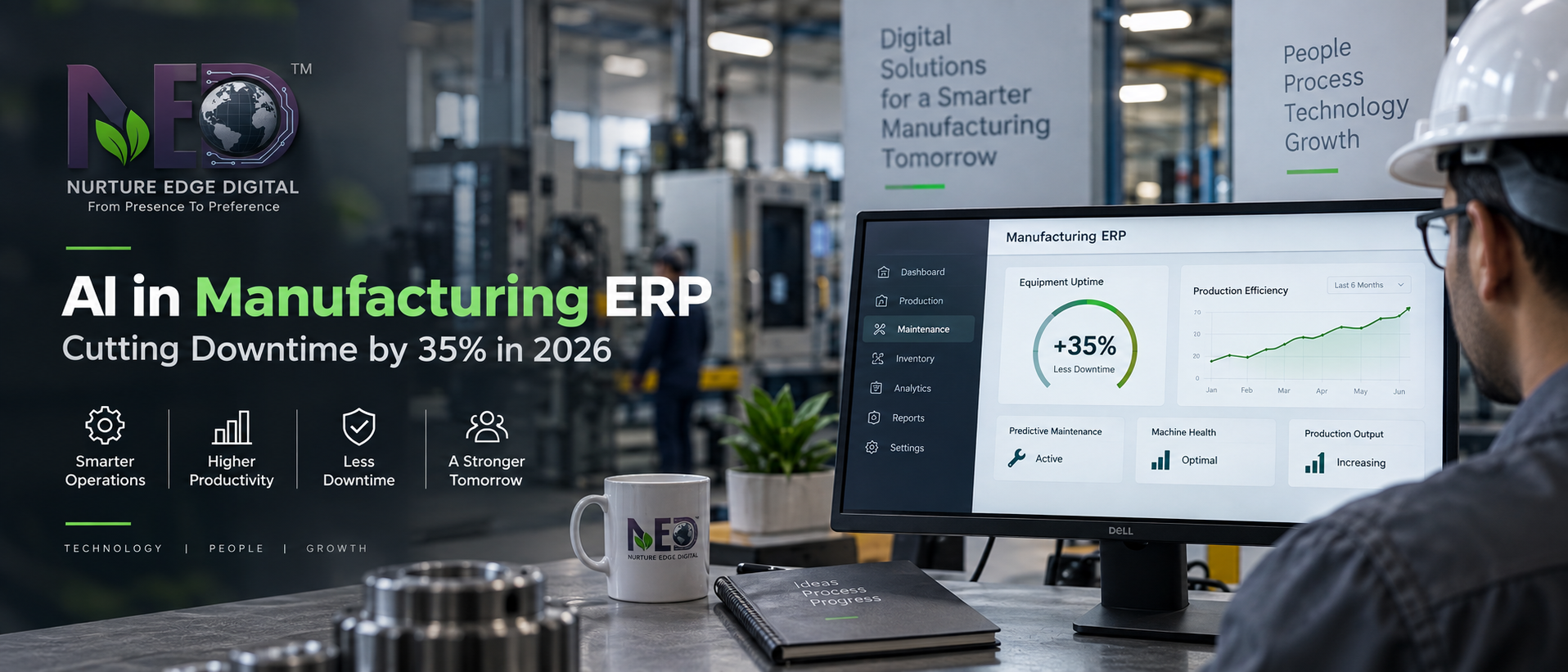
Manufacturing downtime can disrupt production schedules, delay customer orders, increase labor costs, and reduce equipment utilization. In 2026, manufacturers are increasingly using connected ERP systems and intelligent automation to identify problems earlier and respond faster.
AI integration for manufacturing ERP is helping manufacturers connect production data, inventory records, maintenance information, purchasing, and workforce activity in one operational environment. Instead of waiting for a machine failure or production delay to affect the entire operation, businesses can use current data to identify warning signs and take action sooner.
The result can be fewer production interruptions, faster decision-making, and better use of equipment and labor. While the 35% reduction referenced in this article is a benchmark for the discussion rather than a universal industry statistic, it reflects the type of downtime improvement manufacturers are targeting through modern ERP transformation.
Manufacturing downtime can disrupt production schedules, delay customer orders, increase labor costs, and reduce equipment utilization. In 2026, manufacturers are increasingly using connected ERP systems and intelligent automation to identify problems earlier and respond faster.
AI integration for manufacturing ERP is helping manufacturers connect production data, inventory records, maintenance information, purchasing, and workforce activity in one operational environment. Instead of waiting for a machine failure or production delay to affect the entire operation, businesses can use current data to identify warning signs and take action sooner.
The result can be fewer production interruptions, faster decision-making, and better use of equipment and labor. While the 35% reduction referenced in this article is a benchmark for the discussion rather than a universal industry statistic, it reflects the type of downtime improvement manufacturers are targeting through modern ERP transformation.
What Is AI Integration in Manufacturing ERP?
AI integration for manufacturing ERP means connecting intelligent software capabilities with an ERP platform so the system can analyze operational data, identify patterns, support decisions, and automate selected processes.
A modern manufacturing ERP can already store information about:
- Production orders
- Raw materials
- Inventory levels
- Purchase orders
- Suppliers
- Machine schedules
- Sales orders
- Workforce activity
- Maintenance requirements
- Financial performance
When intelligent analysis is added, this information becomes more useful for identifying operational problems.
For example, an ERP system may detect that a particular production line frequently experiences delays after a specific component falls below a certain inventory level. The system can flag the situation before the shortage stops production.
This turns ERP from a record-keeping platform into a more proactive operational tool.
Why Manufacturing Downtime Is So Expensive
Downtime does not only mean that a machine has stopped.
A production interruption can create a chain of secondary problems. Workers may remain idle, scheduled orders may be delayed, raw materials may remain unused, and customers may face longer delivery times.
Unplanned downtime can also affect other departments. Procurement may need to arrange urgent material purchases. Sales teams may have to manage delayed orders. Finance may see increased operating costs without corresponding production output.
This is why reducing downtime requires more than improving individual machines. Manufacturers need visibility across the entire workflow.
An integrated AI-powered ERP can connect these processes so managers can see how an operational issue affects production, inventory, purchasing, sales, and costs.
Five Ways AI Is Reducing Manufacturing Downtime
1. Predicting Equipment Problems Earlier
Unexpected equipment failure is one of the most disruptive causes of downtime.
Manufacturers collect information from machines, maintenance records, production schedules, and other operational systems. Intelligent analysis can identify unusual patterns that may indicate a developing problem.
For example, if equipment repeatedly shows declining performance before a failure, the system can flag that pattern. Maintenance teams can then inspect the equipment during a planned maintenance window instead of waiting for an unexpected breakdown.
This approach supports predictive maintenance and helps manufacturers move from reactive repairs toward planned intervention.
2. Improving Production Planning
Poor production planning can create avoidable downtime even when machinery is operating correctly. A production schedule depends on machine availability, material availability, labor, order priorities, and delivery commitments. A change in one area can affect the entire schedule.
AI integration for manufacturing ERP can analyze these connected factors and help planners identify conflicts before production begins.
For instance, if a high-priority order requires a material that is delayed, the system can highlight the potential disruption. Planners can then adjust production sequences, source alternatives, or revise schedules before the issue becomes a stoppage.
Better planning keeps machines productive while reducing avoidable waiting time.
3. Preventing Material Shortages
A machine cannot produce goods if the required materials are unavailable.
Inventory management is therefore closely connected to downtime reduction. Traditional systems may show current stock levels, but manufacturers also need to understand future demand, production requirements, supplier lead times, and purchasing activity.
An AI-powered ERP can use these connected data points to identify potential shortages earlier.
Suppose a component is currently available in sufficient quantities. However, upcoming production orders require more of that component, while the supplier's delivery time has increased. Early identification gives procurement teams time to respond.
This helps prevent a material shortage from becoming a production stoppage.
4. Managing Production Exceptions Faster
Not every disruption can be predicted.
Supplier delays, quality problems, machine faults, labor shortages, and sudden order changes can still occur. The key is how quickly the business identifies and responds to them.
AI integration for manufacturing ERP can help bring exceptions to the attention of the right people. Instead of forcing managers to review multiple reports and systems, the ERP environment can surface important operational changes within the workflow.
This allows teams to focus on decisions that require human judgment rather than spending excessive time searching for information.
5. Connecting Departments Around One Workflow
Manufacturing downtime often crosses departmental boundaries.
A supplier delay affects purchasing. Purchasing affects inventory. Inventory affects production. Production affects sales and customer delivery. Each delay can create another problem downstream.
An integrated ERP environment provides a common operational foundation.
When AI capabilities work within this environment, recommendations can be based on the same business rules, transactions, and data used by the organization. This reduces fragmented decision-making and makes it easier to coordinate responses.
How ERP Data Supports Better Downtime Decisions
The effectiveness of intelligent manufacturing systems depends heavily on the quality and accessibility of ERP data.
Useful information includes:
- Machine and production schedules
- Inventory quantities
- Material requirements
- Purchase orders
- Supplier delivery dates
- Production orders
- Maintenance records
- Customer orders
- Workforce availability
- Quality information
If this information is incomplete, outdated, or inconsistent, automated recommendations can become less reliable.
That is why manufacturers should not treat ERP modernization as separate from their AI strategy. Clean data, clearly defined processes, accurate business rules, and reliable system integrations provide the foundation for useful automation.
What a 35% Downtime Reduction Could Mean
A 35% reduction in downtime can have a significant operational effect.
Consider a factory that experiences 100 hours of downtime over a defined measurement period. A 35% reduction would bring that figure down to approximately 65 hours, eliminating 35 hours of downtime.
The financial effect depends on production volume, labor costs, equipment utilization, product margins, and the value of lost output.
Manufacturers should therefore avoid measuring success only through the number of downtime hours. They should also track:
- Overall equipment effectiveness
- Production output
- Unplanned maintenance events
- Mean time between failures
- Mean time to repair
- Material shortages
- Schedule adherence
- Order fulfillment
- Maintenance costs
- Lost production value
These measures connect operational improvements to actual business outcomes.
How Manufacturers Can Implement AI Without Disrupting Operations
Manufacturers do not need to transform every ERP process at once.
A practical approach starts with one high-value workflow where downtime is measurable. Equipment maintenance, inventory availability, production scheduling, or supplier delays can provide suitable starting points.
First, identify the business problem and the desired outcome. Next, determine which ERP data and processes support that workflow.
Then establish how recommendations will reach employees and how actions will be recorded in the ERP.
Human oversight remains important, especially when decisions can affect safety, production continuity, financial commitments, or customer orders.
Manufacturers should also test the system under different operating conditions and continuously measure whether the expected improvement is actually occurring.
The Role of Human Oversight
Automation does not eliminate the need for experienced manufacturing professionals.
Production managers, maintenance teams, procurement specialists, and finance professionals understand operational conditions that may not be fully represented in system data.
For high-impact decisions, businesses should define who reviews recommendations, which decisions require approval, and how actions are logged.
This approach creates a balance between automation and operational control.
The goal is not to allow software to make every decision. The goal is to give employees better information at the point where decisions need to be made.
What to Look for in a Modern Manufacturing ERP
Manufacturers evaluating an ERP platform should look beyond basic accounting and inventory functions.
A modern system should provide connected capabilities for production, procurement, inventory, sales, finance, HR, and reporting.
Important capabilities include:
- Real-time inventory visibility
- Production planning
- Material requirements planning
- Purchase management
- Supplier tracking
- Maintenance and operational data integration
- Workflow automation
- Business dashboards
- Financial and GST reporting
- Role-based approvals
- Cloud accessibility
- Integration through APIs or standard data services
- Scalable architecture
The system should also make operational information accessible where employees actually perform their work.
The Future of Manufacturing ERP in 2026
Manufacturing ERP is moving toward more connected and proactive operations. AI agents, predictive analytics, automation, conversational interfaces, and intelligent dashboards are increasingly being incorporated into enterprise software.
However, technology alone will not eliminate downtime.
The strongest results come from combining reliable ERP data, well-defined workflows, skilled employees, appropriate automation, and continuous measurement.
AI integration for manufacturing ERP can help manufacturers identify problems earlier, coordinate departments, and act on operational information faster. But the business must first establish accurate processes and reliable data.
As manufacturers move from isolated technology experiments toward enterprise-wide transformation, ERP becomes an important foundation for scaling these capabilities.
Drive Smarter Manufacturing Growth With Expert AI Integration
With 3+ years of experience and a growing record of successful project delivery, Nurture Edge Digital helps businesses navigate digital transformation with practical, results-focused strategies. Our approach to AI integration for manufacturing ERP focuses on connecting technology with measurable business outcomes, from streamlined workflows to improved operational visibility. With a 98% client satisfaction rate, we prioritize lasting partnerships, dependable execution, and solutions aligned with business goals. Choose Nurture Edge Digital to build smarter, more efficient manufacturing operations.
Conclusion
Reducing downtime requires manufacturers to understand the full workflow behind production interruptions. Equipment condition, inventory, purchasing, scheduling, workforce availability, and customer requirements are interconnected. AI integration for manufacturing ERP brings these elements closer together, helping organizations identify risks earlier and respond within established workflows.
The 35% benchmark should be evaluated against each manufacturer's own baseline, production environment, and measurement period. What matters is whether the technology produces measurable improvements in uptime, output, maintenance, cost, and service levels.
Manufacturers that combine strong ERP foundations with targeted automation can build a more responsive operation without losing human oversight. Ready to turn smarter ERP data into measurable manufacturing performance? Connect with Nurture Edge Digital and take the next step toward a more efficient operation.
FAQs
1. How does AI integration for manufacturing ERP reduce downtime?
AI integration for manufacturing ERP helps identify equipment issues, material shortages, scheduling conflicts, and production exceptions earlier. This enables manufacturers to take corrective action before minor disruptions develop into costly downtime.
2. What features should an AI-powered ERP have for manufacturing?
An AI-powered ERP should connect production planning, inventory, procurement, maintenance data, sales, finance, and workforce information. Real-time dashboards, workflow automation, predictive insights, APIs, and role-based approvals can further improve operational visibility.
3. How should manufacturers start AI integration for manufacturing ERP?
Start with one measurable workflow, such as predictive maintenance, inventory availability, or production scheduling. Define the desired outcome, connect the necessary ERP data, establish human oversight, test the workflow, and measure results before expanding.
4. Is AI integration for manufacturing ERP secure?
Security depends on the ERP architecture, integrations, access controls, and governance practices. Manufacturers should use controlled data access, role-based permissions, action logging, testing, and human approval for high-impact decisions.
5. What makes AI integration for manufacturing ERP different from standalone AI tools?
AI integration for manufacturing ERP works within existing business workflows, data, transactions, and rules. Unlike standalone tools, it can connect recommendations directly to operational processes, helping reduce fragmented decisions and improve end-to-end visibility.
 Nurture Edge Digital LLP