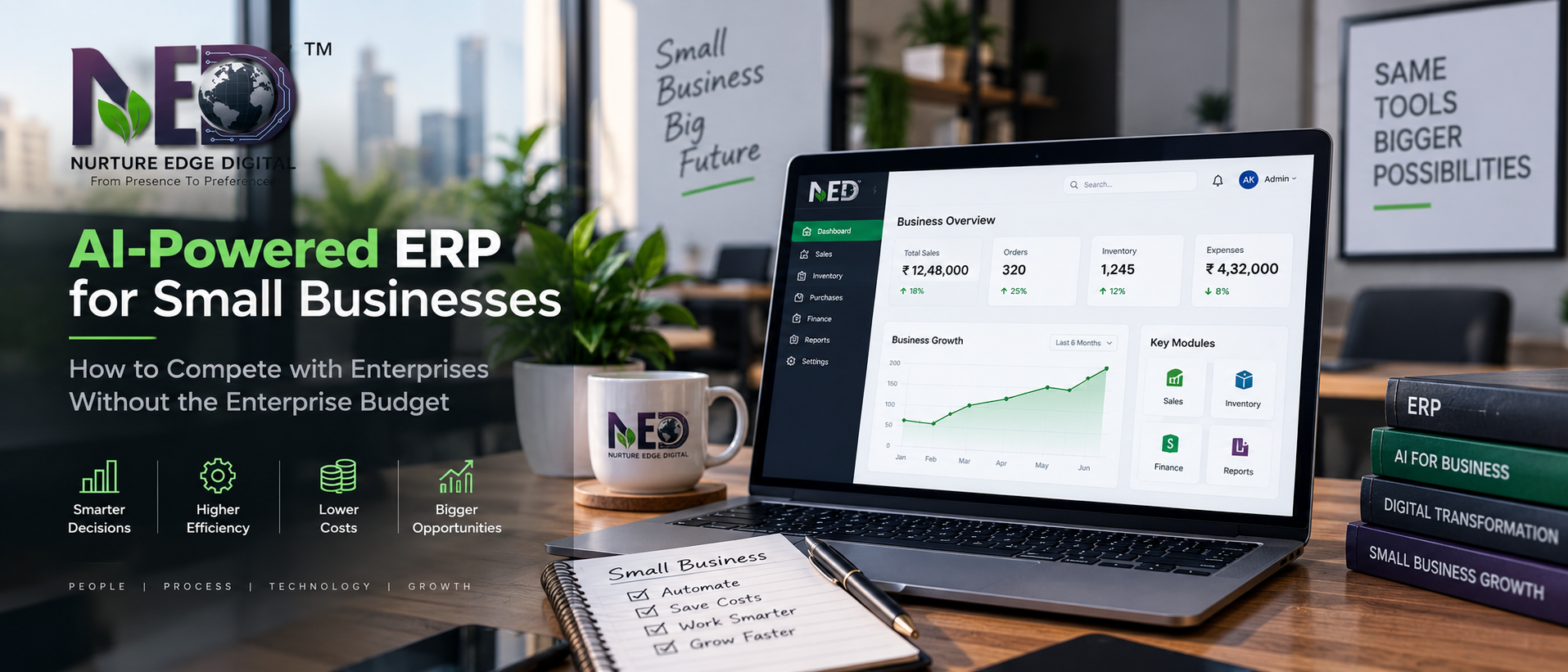
Small businesses may not have the staff, technology budgets, or administrative resources of large enterprises. But they face the same demands: accurate financials, dependable inventory, efficient purchasing, responsive customer service, and timely decisions.
An AI-powered ERP for small business can narrow that gap. It brings core operations into one connected platform while using artificial intelligence to automate repetitive tasks, recognize patterns, forecast demand, and uncover actionable insights.
The aim is straightforward: help smaller teams do more, work smarter, and grow without unnecessary complexity or added headcount.
Small businesses may not have the staff, technology budgets, or administrative resources of large enterprises. But they face the same demands: accurate financials, dependable inventory, efficient purchasing, responsive customer service, and timely decisions.
An AI-powered ERP for small business can narrow that gap. It brings core operations into one connected platform while using artificial intelligence to automate repetitive tasks, recognize patterns, forecast demand, and uncover actionable insights.
The aim is straightforward: help smaller teams do more, work smarter, and grow without unnecessary complexity or added headcount.
What Is an AI-Powered ERP for a Small Business?
An AI-powered ERP combines traditional enterprise resource planning with artificial intelligence to bring core business functions into one connected system. It links accounting, sales, purchasing, inventory, manufacturing, CRM, and human resources while using business data to automate routine tasks and support smarter decisions.
Unlike a conventional ERP that primarily records transactions, an AI-enabled system can analyze data, recognize patterns, and anticipate what may come next. It can forecast cash flow, predict inventory needs, flag unusual activity, and deliver real-time insights to management.
For small businesses, that means fewer scattered spreadsheets, less manual coordination, and a clearer view of the business as a whole.
Why Is AI-Powered ERP Important for Small Businesses?
The main value comes from combining automation, centralized data, forecasting, and decision support.
A small company may have one employee handling several administrative responsibilities. When routine work increases, errors and delays can follow. AI can take over suitable repetitive processes while employees focus on customers, production, planning, and growth.
Key Benefits at a Glance
|
Business challenge
|
How AI-enabled ERP can help
|
|
Manual data entry
|
Automates repetitive information processing
|
|
Uncertain cash flow
|
Uses historical data for financial forecasting
|
|
Overstocking
|
Predicts demand and purchasing requirements
|
|
Stockouts
|
Identifies changing inventory needs
|
|
Slow reporting
|
Provides real-time dashboards
|
|
Complex software
|
Supports natural-language queries and AI copilots
|
|
Departmental silos
|
Connects finance, sales, inventory, and operations
|
|
Rising administrative workload
|
Handles more processes without proportional staffing
|
This makes an AI-powered ERP for small business particularly useful for companies that are growing faster than their existing systems can handle.
How Does AI Improve Cash-Flow Forecasting?
Cash-flow management becomes difficult when sales, expenses, invoices, and payments are tracked separately.
AI can analyze historical transactions alongside current financial activity to identify recurring patterns. Businesses can use these forecasts to anticipate potential shortfalls and review spending before problems become urgent.
For example, a manufacturer may notice that customer payments regularly slow during a particular period. A forecasting system can help management compare expected receipts with upcoming supplier payments, payroll, and other commitments.
Financial Information in One Place
An integrated ERP can bring together:
- Accounts receivable and payable
- General ledger and journal entries
- Profit and loss statements
- Balance sheets
- Bank reconciliation
- GST reconciliation
- Invoices and payment records
- Cash inflows and outflows
This creates a clearer financial picture without requiring employees to combine information manually.
How Can AI Make Inventory Management More Accurate?
Inventory planning is a balancing act. Excess stock ties up working capital. Insufficient stock can delay production or customer orders.
An AI-powered ERP for small businesses can examine historical demand, seasonal patterns, current stock levels, and purchasing activity to support better replenishment decisions.
Consider a business that sells products with strong seasonal demand. Instead of relying entirely on guesswork, managers can compare previous sales patterns with current orders and inventory levels.
Manufacturing businesses can also connect inventory with material requirement planning, barcode scanning, rack management, and inward and outward transactions. This provides greater visibility into material movement.
How Does AI Help Managers Make Better Decisions?
AI becomes more useful when it turns large volumes of operational data into information that managers can act on.
An AI-based ERP for businesses can analyze data from finance, sales, procurement, inventory, and operations. Dashboards can then highlight trends, anomalies, and areas that need attention.
For example, procurement managers may see changing supplier patterns. Sales teams can examine customer activity. Production managers can monitor material requirements and operational performance.
From Historical Reports to Predictive Insights
Traditional reporting mainly answers:
“What happened?”
AI-enabled analytics can also help answer:
“What could happen next?”
That distinction matters. A forecast does not guarantee an outcome, but it gives managers another source of evidence before committing resources.
Can AI ERP Reduce Administrative Work?
Yes. One of its clearest applications is automating repetitive processes.
Depending on the platform and workflow, automation can support:
- Invoice matching
- Expense categorization
- Payment reconciliation
- Order processing
- Purchase workflows
- Compliance checks
- Routine reporting
- Attendance and payroll processes
This can reduce the amount of time employees spend moving information between systems.
Consequently, a small team can handle greater transaction volumes without immediately expanding its administrative workforce.
How Does AI Make ERP Easier to Use?
ERP systems can become difficult when employees must navigate multiple screens to find basic information. Natural-language interfaces and AI copilots offer another approach. Users may be able to request a report, locate a record, or ask a business question using ordinary language rather than complex menu paths.
An AI-based ERP for businesses can therefore make advanced business software more accessible to non-technical employees.
This is especially relevant for small organizations without dedicated IT or ERP administration teams.
How Can ERP Connect Different Business Departments?
A growing company needs information to move smoothly between departments. An integrated ERP can connect CRM, sales, purchasing, inventory, manufacturing, accounting, HR, and management reporting within one environment.
For example, a customer order can affect production planning. Production requirements can influence purchasing. Purchasing affects inventory, while related transactions flow into accounting. This connected workflow reduces duplicate data entry and gives employees a consistent view of business activity.
Supporting Manufacturing Operations
For manufacturers, ERP integration can extend from customer orders to the shop floor. Useful capabilities may include:
- Production planning
- Material requirement planning
- Resource allocation
- Shop-floor management
- Inventory tracking
- Supplier coordination
- Sales and order management
- Project accounting
- Workforce management
The exact configuration should reflect the company's processes rather than forcing every business into the same workflow.
What Should Small Businesses Look for in an AI ERP?
Start by aligning ERP selection with business requirements, not a list of fashionable AI features.
Look for a platform that offers:
- Real-time dashboards for operational visibility.
- Integrated accounting for financial control and reporting.
- Inventory management for stock accuracy and planning.
- Purchasing tools for supplier and procurement workflows.
- CRM and sales management for customer operations.
- Workflow automation for repetitive processes.
- Cloud access for teams working across locations or devices.
- Scalability as transaction volumes and departments increase.
- Industry-specific functionality where specialized workflows matter.
- Implementation support covering process mapping, testing, training, and refinement.
An AI-based ERP for businesses should solve measurable operational problems. A sophisticated feature has little practical value if employees cannot use it or if it does not fit the company's workflow.
How Should a Small Business Implement AI ERP?
A phased approach can make implementation easier to manage.
1. Identify Operational Bottlenecks
Start by documenting recurring problems. These might include inaccurate stock records, delayed purchasing, manual reconciliation, or slow management reporting.
2. Map Existing Processes
Document how information currently moves between sales, purchasing, production, finance, inventory, and HR.
3. Configure and Test
Develop the required workflows, integrate relevant modules, and test real business scenarios before full deployment.
4. Review and Improve
After implementation, monitor adoption and identify processes that need adjustment. AI systems can become more useful as they receive additional business data and feedback.
The Real Business Value of AI ERP
The strongest case for AI-enabled ERP is not simply that it uses artificial intelligence.
Its value comes from connecting business information, reducing repetitive work, improving forecasting, and giving decision-makers timely visibility.
A small company does not need to replicate a multinational corporation's technology budget. It needs systems that help its existing people work efficiently and make informed decisions.
Build Smarter Operations with AI-Powered ERP
Nurture Edge Digital helps growing businesses explore practical AI-powered ERP solutions that connect finance, inventory, sales, procurement, and operations. Our approach focuses on real business needs, from automating repetitive workflows to improving forecasting and real-time visibility. With a people-first digital strategy, we help businesses identify opportunities to work more efficiently, make informed decisions, and scale with confidence. Whether you are modernizing legacy processes or planning a connected ERP ecosystem, our expertise can help turn complex business data into meaningful operational value.
Conclusion
An AI-powered ERP for small business can give growing companies a practical way to improve financial control, inventory planning, purchasing, customer management, reporting, and daily operations.
The right platform does more than automate tasks. It connects information across the organization and helps managers understand what is happening, identify emerging patterns, and respond with better evidence.
Before investing, businesses should define their operational priorities, evaluate integration requirements, and choose capabilities that can grow with them.
For organizations exploring this transition, Nurture Edge Digital can help identify practical opportunities for AI-enabled ERP and connected business operations.
FAQs
1. What are the main benefits of AI-powered ERP for small businesses?
An AI-powered ERP helps small businesses automate repetitive work, improve cash-flow forecasting, manage inventory, connect departments, and access real-time insights without maintaining a large administrative team.
2. What features and integrations should a small business look for in an AI ERP?
Look for accounting, CRM, sales, purchasing, inventory, manufacturing, HR and payroll, dashboards, workflow automation, cloud access, and integrations that connect data across core business operations.
3. How much does AI ERP cost, and how long does implementation take?
Costs and timelines vary by business size, modules, customization, and data requirements. A phased process involving process mapping, configuration, testing, training, and refinement can make onboarding more manageable.
4. Is AI-powered ERP secure enough for financial and business data?
Security depends on the ERP provider and its controls. Before choosing a platform, review access permissions, data protection, backup practices, authentication, compliance measures, and how sensitive business information is managed.
5. How is AI ERP different from traditional ERP software?
Traditional ERP mainly records and organizes transactions. AI ERP can additionally analyze patterns, forecast trends, automate workflows, flag anomalies, and provide decision-support insights from connected business data.
 Nurture Edge Digital LLP